
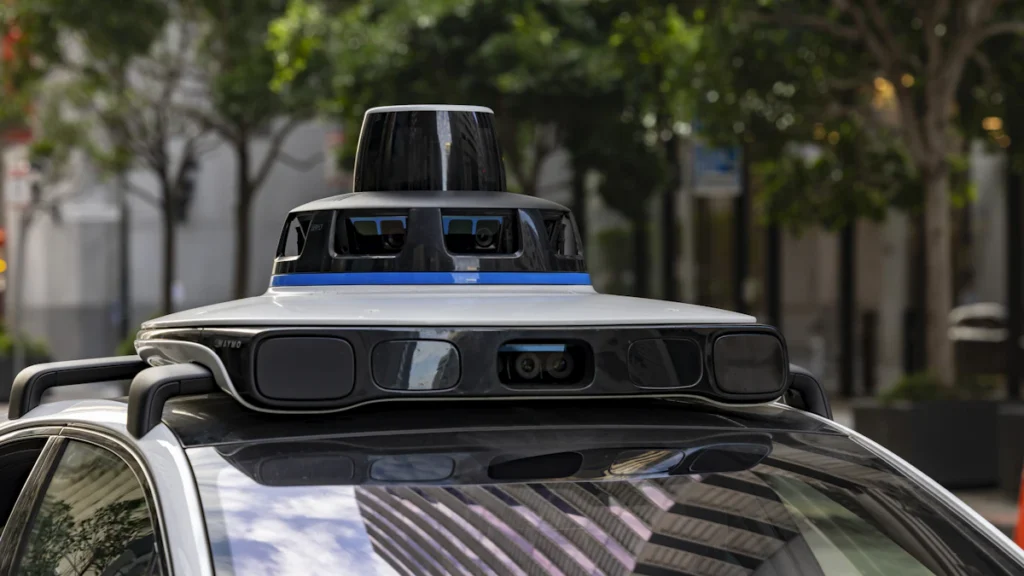
Robotaxis are taxis that drive themselves, with no human behind the wheel, booked through an app like Uber. As of late 2026 they are a real, everyday service in a growing number of US cities, led by Waymo, with Tesla expanding in Texas and Florida and London still in the testing and supervised-trial stage. The honest answer to “who is really driving?” is: software, backed by remote human support.
In this post I will explain how robotaxis work, where they operate, what the safety numbers say and what it all means for riders, drivers and local businesses.
How do robotaxis actually work?
A robotaxi combines three jobs that a human driver does without thinking:
- Sensing. Cameras, and for many companies radar and lidar (a laser sensor that builds a 3D picture of the surroundings), detect cars, pedestrians, cyclists, signs and road markings.
- Predicting. AI models trained on millions of miles of driving estimate what everything around the car is likely to do next.
- Planning and control. The software chooses a safe path and speed, then steers, accelerates and brakes.
Most operators also use detailed maps of their service area and stay within approved zones, known as a geofence. If the car gets stuck or confused, it can ask a remote operator for guidance, though in most systems the remote team advises rather than steering the car directly.
Different companies take different technical bets. Waymo uses a full suite of lidar, radar and cameras. Tesla relies on cameras and a large neural network trained on data from its customer fleet. If you want to understand how that kind of training works, my explainer on how AI works covers the basics.
Where are robotaxis operating in 2026?
Waymo is the clear leader. By March 2026 it was providing about 500,000 paid rides a week across ten US metro areas, including Phoenix, San Francisco, Los Angeles, Austin, Atlanta and Miami, according to TechCrunch’s ridership chart. That was up from about 50,000 a week in May 2024.
Tesla launched its robotaxi service in Austin in 2025 and has been removing safety monitors from some cars. By August 2026, independent tracking reported by The Next Web suggested Tesla’s Austin rides were running without monitors on board, with driverless cars also appearing in other Texas and Florida cities. Tesla publishes little detailed data, so outside observers rely on crowdsourced tracking.
London is the main European test bed. Wayve and Uber began supervised autonomous rides in September 2026 with a trained driver in the seat. Waymo has been testing in London with specialists behind the wheel and, according to its UK page, needs approval from the Department for Transport and consent from Transport for London before offering driverless commercial rides.
China also has large robotaxi programmes run by companies such as Baidu, though the rules and business models there are quite different from those in the US and Europe.
Are robotaxis safe?
This is the question most people care about, and the data so far is encouraging, with caveats.
Waymo publishes regular safety comparisons. In its September 2026 update, covering more than 270 million fully driverless miles through June 2026, Waymo reported 82% fewer injury-causing crashes and about 95% fewer crashes involving serious injury or worse than human drivers on comparable roads. Those comparisons are produced by Waymo itself, but they use published methods and have been reviewed by outside researchers and insurers.
Some caveats are worth keeping in mind:
- Results from one company do not automatically apply to others with different technology.
- Robotaxis still make odd mistakes, such as blocking emergency vehicles or getting stuck at unusual roadworks.
- Most operations are in areas with good weather and well-mapped roads. Snow, heavy rain and chaotic city centres are harder.
Who is responsible when a robotaxi crashes?
When there is no driver, responsibility shifts towards the company operating the vehicle. In the US, rules vary by state, and federal safety regulators can investigate defects and order recalls. In the UK, the Automated Vehicles Act 2024 sets out that when a vehicle is driving itself under an approved system, the authorised company behind the system, not the person inside, is generally responsible for how it drives. The detailed regulations for driverless passenger services were still being finalised in late 2026.
This is not legal advice, but the direction of travel on both sides of the Atlantic is clear: the operator carries the responsibility.
What robotaxis mean for jobs and cities
Robotaxis raise real questions for the millions of people who drive for a living. In the short term, the impact is limited, because services still operate in a limited number of cities with relatively small fleets. Over a decade, if costs fall and services spread, the effect on taxi and ride-hail work could be significant.
There are other effects too:
- Accessibility. People who cannot drive, including some disabled and older people, may gain more independence.
- Traffic and parking. Cities may need fewer parking spaces but could see more empty cars circulating.
- New jobs. Fleet maintenance, cleaning, charging, remote assistance and safety work.
For a broader view, my post on whether AI will take your job looks at which roles are most exposed.
What this means for you and local businesses
If you live in a robotaxi city, you can try a ride and judge for yourself. Start with short daytime trips, read the operator’s safety information and know how to contact support from the app.
For local businesses, robotaxis are another way customers arrive. Accurate addresses, pickup points and opening hours on your website and maps listings matter more when software, not a person, is finding your door. My guide to schema markup for AI search covers how to make that information clear to machines. And if you want to automate bookings or customer messages around this kind of change, my AI automation service can help.
FAQ
Are robotaxis really driverless?
In Waymo’s US service areas, yes: there is nobody in the driver’s seat, though remote staff can give the car guidance if it gets stuck. Tesla has been removing safety monitors in some cities. In London, rides in late 2026 still had a trained safety driver because driverless commercial operation needed further approval.
Where can I ride a robotaxi?
As of 2026, Waymo operates paid driverless rides in ten US metro areas including Phoenix, San Francisco, Los Angeles, Austin, Atlanta and Miami. Tesla runs services in parts of Texas and Florida. In London, Wayve and Uber offer supervised autonomous rides, with Waymo awaiting approval for driverless service.
Are robotaxis safer than human drivers?
Waymo’s own data, covering more than 270 million driverless miles, shows far fewer injury crashes than human drivers on similar roads. That is promising, but it applies to Waymo specifically, in its current cities and conditions. Independent oversight and more data from other companies are still needed before drawing broad conclusions.
How much does a robotaxi ride cost?
Prices vary by city, distance, time of day and demand, much like Uber or Lyft. Robotaxis are not yet dramatically cheaper everywhere, because the vehicles and sensors are expensive. Operators hope costs will fall as fleets grow and vehicles become cheaper to build, so compare prices in the app before you ride.
When will robotaxis come to Europe?
London is likely to be first in Europe. Supervised trials began in 2026, and Waymo has said it aims to launch driverless rides once the UK’s passenger pilot rules are finalised and Transport for London gives consent. Other European cities are further behind, with rules set nationally and through the EU.