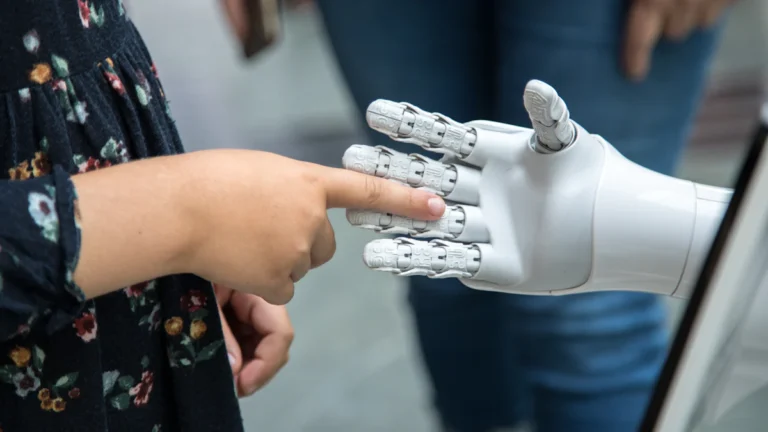

AI companions can feel like friends, and for some people they genuinely ease loneliness for a while. But a chatbot cannot care about you the way a person can, and research so far suggests that heavy, emotionally intense use is linked with more loneliness, not less. The honest answer is that AI companions can be a helpful supplement for some people and a risky substitute for others.
In this post I will explain what AI companions are, why people use them, what the studies actually say, how regulators in the US are responding, and how to use these apps in a healthy way.
What are AI companions?
An AI companion is a chatbot designed for ongoing personal conversation rather than for getting tasks done. Instead of asking it to write an email, you chat with it about your day, your worries or your interests. Many apps let you give the companion a name, a personality and sometimes an avatar or voice.
They run on the same kind of technology as general assistants like ChatGPT: large language models that predict likely responses based on patterns in huge amounts of text. If you want the basics, my explainer on how AI works in plain English covers it. The difference is in the design. Companion apps are tuned to be warm, attentive and always available, and many remember details you have shared before.
People also use general chatbots this way, even when they were not built as companions. That matters, because a lot of emotional use happens in tools that were never designed for it.
Why do people turn to AI companions?
The reasons are very human:
- Availability. A chatbot answers at 3am, never gets tired and never changes the subject to itself.
- No judgement. Some people find it easier to say difficult things to a machine than to a person.
- Practice. People with social anxiety sometimes use companions to rehearse conversations.
- Isolation. Older adults living alone, people who have moved countries, carers and people with long-term illness may have fewer chances to talk.
- Curiosity and entertainment. Plenty of users simply enjoy role play or storytelling.
None of these reasons are silly. The question is whether the companion helps people connect more with others, or quietly replaces that connection.
Do AI companions reduce loneliness? What the research says
The evidence is still early, but a few studies give a useful picture.
In 2025, OpenAI and the MIT Media Lab published two linked studies. One was a four-week randomised trial with about 1,000 participants, the other an automated analysis of millions of ChatGPT conversations. As Fortune reported, people who used the chatbot more each day tended to report more loneliness, more emotional dependence and less socialising with real people. Voice chat seemed to help at first, but that benefit faded at high levels of use.
A separate MIT Media Lab study, presented at an AI ethics conference in 2025, surveyed 404 regular users of companion apps. It found that chatbot use alone did not directly predict loneliness. Personality, the size of someone’s social network and problematic use patterns mattered more. The researchers identified several distinct types of user: some gained social confidence, while others risked becoming more isolated.
Two important caveats:
- Most findings are correlations. Lonely people may use chatbots more, rather than chatbots making people lonely.
- Effects vary a lot between individuals. A one-size-fits-all verdict does not fit the data.
What are the risks of AI companions?
Even if the average effect is modest, some risks deserve attention:
- Emotional dependence. A companion that is always agreeable can become easier than real relationships, which involve friction and compromise.
- Engagement-driven design. Some apps make money from time spent or paid features, which creates an incentive to keep you chatting.
- Poor responses in a crisis. Chatbots are not trained clinicians and can respond badly to someone in distress.
- Privacy. People share intimate details with companions. Those conversations may be stored, reviewed or used to train future models.
- Young users. Teenagers are still developing socially and may be more vulnerable to intense attachment.
I want to be clear on one point. If you are struggling with your mental health, a chatbot is not a replacement for a doctor, therapist or crisis line. In the US you can call 988, and in the UK and Ireland Samaritans can be reached on 116 123.
How are regulators responding?
In the US, two developments stand out. In September 2025 the Federal Trade Commission sent orders to seven companies, including Alphabet, Meta, OpenAI, Snap, xAI and Character.AI’s parent company, asking how they test companion chatbots for harm, protect children and teens, and make money from engagement.
In October 2025 California signed SB 243, which TechCrunch described as the first state law aimed at AI companions. Taking effect on 1 January 2026, it requires operators to make clear users are talking to AI, to have protocols for responding to suicide and self-harm, to remind minors to take breaks, and to stop chatbots presenting themselves as healthcare professionals.
In Europe, the EU AI Act includes transparency duties so that people know when they are dealing with an AI system. My EU AI Act guide for businesses explains how those rules apply. This is not legal advice, and rules are still evolving on both sides of the Atlantic.
How to use AI companions in a healthy way
If you or someone you care about uses AI companions, these habits help:
- Treat it as a supplement. Use it alongside friends, family and community, not instead of them.
- Notice how you feel afterwards. Calmer and more ready to reach out is good. More withdrawn is a warning sign.
- Set time limits. The research points to heavy daily use as the main concern.
- Be careful what you share. Read the privacy settings and avoid sharing anything you would not want stored.
- Talk to young people about it. Ask what they use and why, without judgement.
What this means for businesses using chatbots
Most small businesses will never build a companion app, but many now use chatbots with customers. The same lessons apply: be upfront that it is AI, make it easy to reach a human, and design for helpfulness rather than keeping people chatting. I cover the balance in my post on AI chatbots versus human support, and through my AI automation service I set up chatbots with clear handoffs to real staff.
FAQ
Can an AI companion be a real friend?
An AI companion can be pleasant, supportive and available whenever you want to talk, but it does not have feelings, memories of a shared life or any stake in your wellbeing. Most experts see it as a tool that can offer comfort, not as a replacement for human friendship and the mutual care it involves.
Do AI companions make loneliness worse?
It depends on the person and how they use it. Studies from 2025 linked heavy daily use with more loneliness and emotional dependence, but the findings are correlations. Some users report gaining confidence. Moderate use alongside real relationships appears much lower risk than relying on a chatbot for most social contact.
Are AI companion apps safe for teenagers?
Teenagers can be more vulnerable to intense attachment and to harmful content, which is why US regulators and California lawmakers have focused on minors. Parents should check age ratings, review privacy and safety settings, keep conversations open and watch for signs of withdrawal or secrecy around the app.
Is it safe to tell an AI companion personal things?
Be cautious. Conversations may be stored on company servers, reviewed for safety or used to improve models, depending on the app and your settings. Avoid sharing financial details, passwords, health information or anything about other people that you would not want kept. Read the privacy policy before getting personal.
Can an AI chatbot replace therapy?
No. A chatbot is not a licensed professional, cannot assess risk properly and may respond poorly in a crisis. Some people find chatbots useful for journaling or organising their thoughts, but anyone struggling with their mental health should speak to a doctor, therapist or crisis service for proper support.